Royal Quiet Deluxe Serial Numbers
Posted : admin On 16.09.2019Sep 26, 2004 The serial number as far as I can see is 259168 cannot see a name or model number. Anyone have any info on this machine. It is very good condition, everything working, platen in excellent condition with ribbon containers and covers and ribbon. Royal Khm Typewriter Manual Typewriters may come and typewriters may go, but I'd like to keep my standing in-house. Serial numbers first run up to 16000, 1723000, 1935, 'KHM' started at 1850000. Vintage ROYAL Shiny Black QUIET DELUXE or Model O Manual Portable Typewriter. $ Vintage Royal KHM Touch.
| Private company | |
| Industry | Typewriters |
|---|---|
| Founded | 1904[1] |
| Founder | Edward B. Hess[2] |
| Headquarters | Hartford, Connecticut , |
| Products | See Typewriters section |
The Royal Typewriter Company was a manufacturer of typewriters headquartered in New York City with its factory in Hartford, Connecticut.
History[edit]
The Royal Typewriter Company was founded by Edward B. Hess and Lewis C. Myers in January 1904 in a machine shop in Brooklyn, New York.
In 1905, with their limited cash running out, Hess and Myers turned to Thomas Fortune Ryan, the wealthy financier. They demonstrated their machine which had numerous innovations including: friction-free, ball-bearing, one-track rail to support the weight of the carriage, a new paper feed, a lighter and faster typebar action, and complete visibility of the words as they are typed. Ryan was impressed and put up $220,000 in exchange for financial control.
In March 1906 the first Royal typewriter, the Royal Standard, was sold. The Royal Standard was different from its competition in that it had a 'flatbed' design.
With demand increasing, Royal purchased 5¼ acres in Hartford, Connecticut, as the new site for its manufacturing facility. Original plans called for floor capacity of 250,000 square feet (23,000 m2) and cost $350,000 to build. In 1908, Royal began manufacturing there.
In 1911, Royal introduced the Royal 5 typewriter, which also utilized the 'flatbed' design.
Royal's first model utilizing the 'upright' design was the Royal 10, which came out in 1914. Original models had two beveled glass panes on each side.
In 1926 Royal introduced the 'Roytype' brand name for its line of typewriter ribbons and carbon paper.
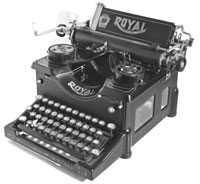
Royal entered the portable typewriter market in 1926 - years behind its competitors such as Underwood, LC Smith Corona, and Remington.
In order to promote the new portable Royal president G. E. Smith secured the exclusive sponsorship of the September 23, 1926, Dempsey–Tunney championship fight for $35,000.[3] This boxing match was the first nationwide radio hook-up.
'The Daily News' of New York estimated that 20 million fans from coast to coast listened to the broadcast.
Royal's introduction of its portable line of typewriters was an immediate success and launched the company to become the world's #1 selling typewriter brand.
On October 9, 1926, the 'Hartford Daily Courant' reported that Royal had just produced its one millionth typewriter.
To promote the ruggedness of its typewriters, George Edward Smith, president of Royal, bought a Ford-Stout tri-motor airplane in August 1927. This plane, commonly called the Royal Airtruck, dropped over 200 typewriters in crates with parachutes to dealers over the eastern seaboard of the USA on its maiden flight. Royal eventually delivered over 11,000 typewriters this way with only ten being damaged.
In January 1941, Edward B. Hess, one of Royal's founders and vice presidents, died in Orlando, Florida. Hess was a prolific inventor and held over 140 patents relating to the typewriter.
World War II brought tremendous change to Royal. In order to aid the war effort, Royal converted its manufacturing to war work exclusively. Royal manufactured machine guns, rifles, bullets, propellers, and spare parts for airplane engines. It wouldn't be until September 1945 that Royal started typewriter production full-time again and not until December 1948 that it caught up on its pre-war backlog.
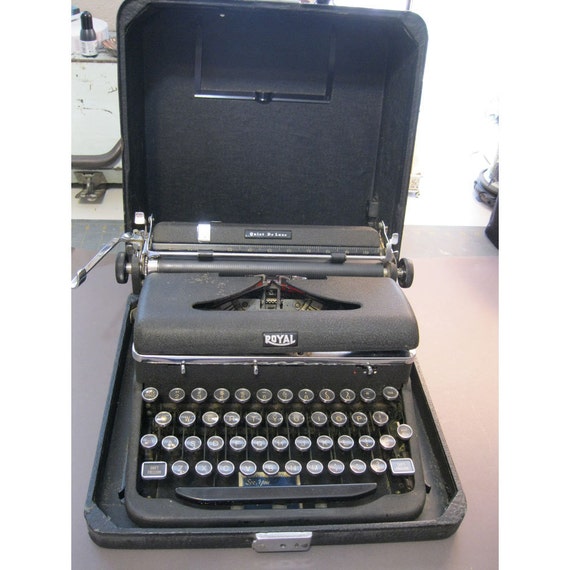
In 1947, Royal produced, in limited quantity, a gold-plated version of its popular Quiet Deluxe model. Ian Fleming, the British novelist who wrote the James Bond novels, used one. Many other writers, including Ernest Hemingway, used a Royal typewriter.
Other typewriter manufacturers utilized Royal's innovations in their typewriters. In 1947, Royal won patent suits against Remington and LC Smith Corona.
In February 1950, Royal introduced its first electric typewriter.
Lewis C. Myers, the surviving founder of the Royal Typewriter Company, died in Freeport, New York at the age of 84.
Worldwide demand caused Royal to open a new factory in Leiden, the Netherlands, to produce typewriters in 1953.
In April 1954, the Royal typewriter Company announced its plan to merge with McBee, a leading manufacturer of accounting and statistical machines and supplies. By July, Royal stockholders had approved the plan and Royal McBee was formed.
From 1954 to 1964 sales soared from $84.7 million to over $113 million. Royal McBee was consistently listed as a Fortune 500 company.
In December 1957, Royal announced it had just produced its 10 millionth typewriter. Congratulations were received from U.S. Secretary of Commerce Sinclair Weeks and the Governor of Connecticut, Abe Ribicoff.
In December 1964, Litton Industries' stockholders approved the acquisition of Royal McBee. The deal became final in March 1965. Litton would change the name of Royal McBee back to Royal Typewriter and reorganize the company into five divisions: Royal Typewriter, Roytype Consumer Products, Roytype Supplies, McBee Systems, and RMB.
October 1966 saw Litton announce plans to acquire the English typewriter producer Imperial, through its Royal Typewriter division.
In January 1969, Litton Industries further cemented its hold on the typewriter market by purchasing the German typewriter manufacturer, Triumph Adler. Almost immediately, the U.S. government filed an anti-trust suit against Litton accusing it of creating a monopoly. The FTC ruled in March 1973 that Litton had to divest itself of Triumph Adler. Litton appealed and, in a rare reversal, the FTC issued a ruling in April 1975 stating that Litton could keep Triumph Adler.
In March 1979, Volkswagen, seeking to diversify, announced its intention to acquire a 55% stake in Triumph Adler. Included in the deal was Royal Typewriter.
Sales continued to climb and by 1982 sales in North America of Royal and Triumph Adler totaled over $600 million.
In April 1986, Olivetti, the Italian typewriter/computer manufacturer, announced plans to purchase Triumph Adler and Royal from Volkswagen. For nearly two decades Royal was a part of the Olivetti family.
In September 2004, Royal became a private American company again.
1941 Royal Quiet Deluxe Typewriter
Now known as Royal Consumer Information Products Inc., Royal’s product line has evolved to include cash registers, shredders, personal digital assistants (PDAs)/electronic organizers, postal scales, weather stations, and a wide range of original and compatible/remanufactured imaging supplies supporting today’s most popular printers, faxes, and copiers.
Typewriters[edit]
| Model | Year Introduced | Notes |
|---|---|---|
| Royal 1 (Standard) | 1906 | First model, flatbed design |
| Royal 5 | 1911 | Flatbed, 11' carriage |
| Royal 6 | 1911 | Flatbed, 15' carriage |
| Royal 8 | 1911 | Flatbed, 19' carriage |
| Royal 10 | 1914 | Upright design, Beveled glass sides |
| Royal Portable | 1926 | First portable model |
| Royal Portable (2nd Model) | 1931 | Second portable model |
| Royal Signet | 1932-3 | Depression-era, low-cost portable |
| Royal KHM | 1934 | Round raised cover over ribbons |
| Royal Junior | 1935 | Depression-Era, low-cost portable |
| Royal Standard Portable | 1935 | First Royal with Touch Control |
| Royal Deluxe | 1935 | Touch control, finger comfort keys |
| Royal Model O | 1936 | Portable with touch control, made in the USA. |
| Royal Aristocrat (1st Model) | 1939 | Large portable. Tabs were set manually. |
| Royal KMM | 1939 | Hinged top, touch control, Introduced 'Magic Margin' system |
| Royal Quiet Deluxe Portable | 1939 | |
| Royal Companion (1st model) | 1941 | A Royal Varsity, with a two-color ribbon. |
| Royal Varsity | 1941 | Replaced the Royal Junior and Signet—a low-cost portable typewriter. |
| Royal Quiet Deluxe (2nd model) | 1948 | Designed by Henry Dreyfuss |
| Royal Arrow | 1948 (?) | For military use during World War II |
| Royal KMG | 1949 | Extra long carriage |
| Royal Companion (2nd Model) | 1950 | Designed by Henry Dreyfuss |
| Royal | 1950 | Royal's first electric typewriter |
| Royal Diana | 1953 | Made in Mannheim, Germany. Made until 1959. |
| Royal HH | 1954 | Hinged Top, Touch Control, Portable |
| Royal Royalite | 1955 | Made in Leiden. Small portable. |
| Royal Senior Companion | 1955 | Low-cost, full-size portable typewriter. |
| Royal Companion (3rd model) | 1955 | Lower-cost version of the Senior Companion. |
| Royal Quiet Deluxe (3rd model) | 1955 | Came in a choice of six colors |
| Royal Futura (1st Model) | 1958 | First Royal portable with keyboard-level tab clear/set. |
| Royal Heritage, Heritage Deluxe, Heritage III | 1959 | Essentially a Royal Futura but sold exclusively at Montgomery Ward. |
| Royal All-American | 1961 | Royal Futura body with no 'Magic Margins' or 'Touch Control'. Same as 'Tab-O-Matic' but different color and different luggage case. |
| Royal Aristocrat (2nd Model) | 1961 | Tri-Tone Royal Futura body with no 'Magic Margins.' Similar to 'Tab-O-Matic' and 'All American' but with keys like the Heritage line. |
| Royal Tab-O-Matic (1st Model) | 1961 | Royal Futura body with no 'Magic Margins' or 'Touch Control'. Same as 'All-American' but different color and different luggage case. |
| Royal Eldorado | 1962 | Royalite painted black and gold. |
| Royal Dart | 1962 | A special Royalite made for Montgomery Ward, with a raised ribbon cover. |
| Royal Lark | 1962 | A special Royalite, with a raised ribbon cover. |
| Royal Empress | 1962 | Large, futuristic office typewriter |
| Royalite '64 | 1963 | Royal Royalite, with a two-color ribbon. Offered in either light yellow, or gray. |
| Royal 5000SDW | 1964 | |
| Royal Safari | 1964 | Full-featured portable typewriter. |
| Royal Custom II | 1965 | A full-sized portable typewriter, available in either red or charcoal. One of the last Royal portables to be produced in the United States. |
| Royalite '65 | 1964 | Royalite, with new design, based on the Royal Futura. |
| Royal Skylark | 1965 | A small, plastic-bodied Royalite. |
| Royalite (Model 2) | 1966 | Small plastic typewriter, with snap-on lid. |
| Royal '890' | 1966 | Came in either white, beige, or gray |
| Royal Telstar | 1966 | Basically a Royal Safari, with fewer features, and sold at a lower price. |
| Royal 550 | 1967 | |
| Royal Aristocrat (3rd Model) | 1968 | Similar to Royal Safari. Doesn't have a '1' key but does have a '+' key. |
| Royal Mercury | 1968 | Small metal-bodied portable, made by Silver-Reed, in Japan. Early models are painted ivory. |
| Royal Century | 1968 | Like the Royal Mercury, except painted two-tone blue, with a raised ribbon cover. |
| Royal Signet | 1968 | Like the Royal Mercury; lacks touch control and two-color ribbon. Came in gray |
| Royal Jet | 1968 | Blue version of the Signet. |
| Royal Futura (2nd Model) | 1968 | A gold and white Royal 890 design was sold as the 'Futura' in 1968. |
| Royal Apollo | 1969 | Electric portable typewriter. |
| Royal Jetstar | 1970 | Fully-Electric Personal Typewriter. |
| Royal Tab-O-Matic (second design) | 1972 | Royal Mercury with preset tabulator. Painted dark brown. |
| Royal Sabre | 1972 | One of the first Royal portables to be manufactured in Portugal |
| Royal Astronaut | 1972 | Plastic portable typewriter, with a modernistic design. Made in Japan. |
| Royal Custom III | 1973 | A full-sized portable typewriter available in two tone deep red/white or blue/white. |
| Royal Fleetwood | 1972 | Woodgrained plastic portable, based on Royal Sprite. Made by Silver-Reed. Also called Caravan. Had transistor radio in its case. |
| Royal Sprite | 1972 | Plastic typewriter, with a transistor radio mounted in its case. |
| Royal Sahara | 1975 | A rebadged Adler Tippa S, made of bright-blue plastic. |
| Royal Safari (Model 2) | 1979 | Made in Portugal |
| Royal Cavalier | Pre-1990 | |
| Royal Safari III | 1989 | Made in Korea. Manual portable. |
| Royal Scrittore | ca. 2012 | Made in China. Manual portable. |
| Royal Scrittore II | ca. 2012 | Made in China. Manual portable. |
| Royal Epoch | ca. 2015 | Made in China. Manual portable. |
During the 1980s, Royal also produced consumer daisy wheel printers like the Royal LetterMaster and Royal OfficeMaster 2000, the former being a cheaper model.[4]
In popular culture[edit]
A Royal typewriter is a large story element in Stephen King's novel Misery.
60 Minutes correspondent Morley Safer was known to write all of his scripts on a Royal typewriter.[5]
A Royal typewriter with a Prestige Elite typeface was one of the items found at Zodiac suspect Arthur Leigh Allen's apartment, matching the typewriter the Zodiac killer used to write letters sent to the Riverside Police Department.
Jessica Fletcher used a Royal typewriter to write her novels.
Mason Williams threw a Royal Model X typewriter out of a speeding car driven by Ed Ruscha for their art bookRoyal Road Test (1967).[6]
References[edit]
- ^Fenton, Reuven (November 6, 2007). 'Last word on typewriter not written yet'. The Boston Globe. Retrieved 2008-01-04.
- ^Cortada, James W. (1993). Before the Computer. Princeton University Press. p. 20. ISBN0691050457.
- ^Evensen, Bruce J. (1996). When Dempsey Fought Tunney: Heroes, Hokum, and Storytelling in the Jazz Age. Univ. of Tennessee Press. p. 87. ISBN9780870499180 – via Google Books.
- ^'Buyer's Guide To The Printers Of 1986'. COMPUTE!. June 1986. p. 24. Retrieved 30 Mar 2015.
- ^https://www.theglobeandmail.com/arts/television/in-appreciation-of-morley-safer/article30104050/
- ^https://www.artgallery.nsw.gov.au/collection/works/431.2008.a-ww/
External links[edit]
The Royal Quiet Deluxe was a portable typewriter, made by the Royal Typewriter Company, from 1939 until 1959. The first-generation Quiet Deluxe was the first Royal to feature Magic Margin. The first generation of Royal Quiet Deluxe was manufactured from 1939 until 1948, with a gap in production due to World War II. It was the typewriter of choice for Ernest Hemingway.[1]
Royal Quiet Deluxe Serial Number Location
In the late 1940s, the Royal Quiet Deluxe was redesigned by Henry Dreyfuss. It was redesigned again in 1950, with the corners rounded off. By 1955, it was being offered in a choice of six colors, and gray. According to The Typewriter Database, the last Royal Quiet Deluxe typewriters were made in 1957.[2] Most typewriters called the Quiet Deluxe were made in the United States, except for the later, rounded plastic machines bearing the name 'Quiet Deluxe.' These were made in The Netherlands. The typewriter pictured is a 1954 model, which was made in Hartford, Connecticut.
According to Machines of Loving Grace, an online museum of typewriters by a prolific collector, the Quiet Deluxe was a refinement of the earlier Standard and DeLuxe models. 'The DeLuxe is very similar to the Portable Standard in style and function. It has the addition of a tabulator, a paper guide, and of course its signature 'crinkle' finish and chromed bands. Down the road, the DeLuxe would be merged with the short-lived Quiet model and become one of Royal's most popular models, the Quiet DeLuxe.',[3] and the Quiet Deluxe was later updated to add a cover release, a carriage-return tension adjustment, a remaining-paper guide, and relocated tab adjustments.
The Royal Typewriter Company produced a special edition of the Quiet Deluxe with gold-plated accents,[4] 'Some of these golden models were given as awards to Royal Typewriter company employees. Others were given to high school students who were winners of writing competitions sponsored by Royal Typewriter.'[5]
One of these is reported to have been commissioned by author Ian Fleming 'After finishing the first draft of Casino Royale, Ian Fleming rewarded himself with a Royal Quiet Deluxe Portable gold-plated typewriter, which he used to write the rest of his books and short stories. Fleming bought the gold-plated Royal Quiet Deluxe Portable typewriter from a New York dealer in 1952'.[6] According to the Guinness Book of World Records, this typewriter is the world's most expensive: 'Ian Fleming's gold plated typewriter, which was commissioned by the James Bond writer in 1952, was sold for £56,250 ($90,309) at Christie's, London, UK on 5 May 1995.'[7] Author Ernest Hemingway also used a Quiet De Luxe. 'A manual Royal typewriter that once belonged to Ernest Hemingway, made around 1940 and still in its well-worn leather carrying case, sold for $2,750 at a multi-estate sale held June 24th [2007] by Four Seasons Auction Gallery'[8] in Atlanta, Georgia, although it is not clear whether this typewriter was a Quiet De Luxe or the very-similar Arrow model that Hemingway also used.
References[edit]
- ^'Keystone Typewriter Company'. Keystone Typewriter Company. Retrieved 8 October 2012.
- ^'The Typewriter Database'. The Typewriter Database. Retrieved April 5, 2014.
- ^'Royal Typewriters'. Machines of Loving Grace. Retrieved April 5, 2014.
- ^'Royal Quiet De Luxe gold'. The Virtual Typewriter Museum. Retrieved April 5, 2014.
- ^'Rare Royal 1953 Quiet Deluxe Gold Portable Typewriter Limited Edition - Ian Fleming wrote 007 novels on one!'. Collectors Weekly. Retrieved April 5, 2014.
- ^'The Man With The Golden Typewriter'. Artistic Licence Renewed: An Art and Literary James Bond Blog and Tribute to Richard Chopping. Retrieved April 5, 2014.
- ^'James Bond - 50 of the Best 007-Related Records to Mark 50 Years on the Big Screen'. Guinness World Record News. Retrieved April 5, 2014.
- ^'Hemingway's typewriter hits $2,750 at Four Seasons'. News-Antique.com. Retrieved April 5, 2014.
External links[edit]
- Royal Quiet Deluxe patent on Google Books
- 1955 Advertisement on Google Books
- Two-page ad for Royal Quiet Deluxe, 1950 on Google Books
- Royal Quiet Deluxe ad on Google Books
- Typewriter Database, formerly cited on November 3, 2012 in this article, is defunct as of April 2014. The data from that database has been revived in The Typewriter Database.
- Ian Fleming: Royal Quiet Deluxe has detailed pictures of a model similar to Mr. Fleming's.