How Can I Install Ubuntu From A Usb
Posted : admin On 26.08.2019This guide will help you install Ubuntu on your computer by using a USB memory stick. USB memory sticks are sometimes known as flash drives, memory pens or USB Mass Storage devices. Installing from a memory stick is useful if you have a computer without a CD drive (such as a netbook), or prefer the convenience of a memory stick. .You can also press F12 to enter the boot menu. The next instructions use this method. At the Lenovo screen press F12. Select USB HDD: SanDisk Cruzer Glide to with the arrow keys and hit Enter.
In this article, I will show you how to run Ubuntu 18.04 from a USB stick. Let’s get started.
Installing Ubuntu 18.04 LTS to USB Stick
For this setup to work, you need an Ubuntu 18.04 LTS bootable media. You may burn the Ubuntu 18.04 LTS iso file to a DVD or make a bootable Ubuntu 18.04 USB stick. If you make Ubuntu bootable USB stick, then you need another USB where you can install Ubuntu 18.04 LTS.
If you have a good enough computer, you may install Ubuntu 18.04 LTS to your USB stick from a virtual machine such as VMware.
Once you have a Bootable Media of Ubuntu 18.04 Live DVD, insert it in your computer and boot from it.
Once you see the GRUB menu as shown in the screenshot below, select Try Ubuntu without installing.
Ubuntu 18.04 should start from the live bootable media.
Now insert your USB Stick.
As you can see in the screenshot below, my external USB hard drive is detected. The procedures if you have a USB Stick are the same.
Now double click on the Install Ubuntu 18.04 LTS button as marked in the screenshot below.
Ubuntu 18.04 LTS installer should start. Now click on Continue as marked in the screenshot below.
Now you should see the following window. Select your keyboard layout and once you’re done, click on Continue as marked in the screenshot below.
Now you should see the following window. Mark the Minimal installation checkbox as marked in the screenshot below. Then click on Continue. Don’t mark Install third-party software for graphics and Wi-Fi hardware, MP3 and other media checkbox as you will be running Ubuntu from USB Stick on different hardware. Installing specific hardware may be problematic in that case.
Now click on Yes to unmount all the mounted partitions.
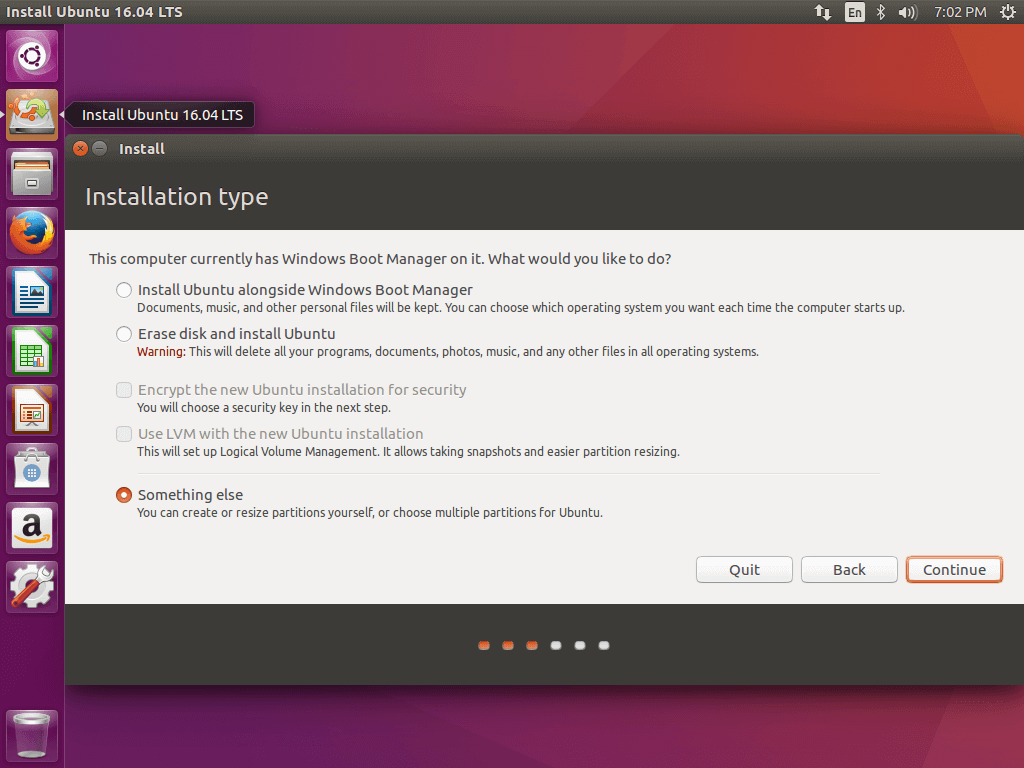
Now click on Something else and then click on Continue.
Now you have to make some partitions. My USB hard drive is /dev/sdc as you can see in the marked section of the screenshot below. Also make sure your USB stick is selected in the Device for boot loader installation section, not any partition such as /dev/sdc1 or /dev/sdc2 etc.
Ubuntu 16.04 Bootable Usb
Now you have to free some disk space in your USB stick. If you want, you can delete all the partitions. We need two partitions. A EFI System Partition and a Root partition.
I will delete /dev/sdc2 and /dev/sdc3 partitions. You can click on – button as marked in the screenshot below to delete a selected partition.
Now I will create /dev/sdc2 EFI System Partition of 512MB and /dev/sdc3 EXT2 partition. Give it at least 20GB of space.
You can click on the + button to create new partitions.
Once you’re done, click on Continue.
Click on Continue to write the changes to the disk.
Now select your time zone and click on Continue.
Now fill in your details and click on Continue.
The installation should start.
Once the installation is complete click on Restart Now.

Now select your USB drive from the BIOS of your computer. Once you select it, Ubuntu should be booted from your USB drive as you can see from the screenshot below.
Problems with Running Ubuntu 18.04 from USB Stick
The only problem when you run Ubuntu 18.04 from USB stick is your USB stick will wear off faster. Because USB sticks are not made to endure too much read and write iterations. It may get permanently damaged.
That’s how you run Ubuntu 18.04 from a USB Stick. Thanks for reading this article.
Want to try out Ubuntu, but not sure where to start? There are lots of ways to try out Ubuntu – you can even install it on Windows and uninstall it from your Control Panel if you don’t like it.
Ubuntu can be booted from a USB or CD drive and used without installation, installed under Windows with no partitioning required, run in a window on your Windows desktop, or installed alongside Windows on your computer.

Boot From a Live USB Drive or CD
One of the easiest ways to get started with Ubuntu is by creating a live USB or CD drive. After you place Ubuntu on the drive, you can insert your USB stick, CD, or DVD into any computer you come across and restart the computer. The computer will boot from the removable media you provided and you’ll be able to use Ubuntu without making any changes to the computer’s hard drive.
To create a Ubuntu USB drive or CD, download the latest Ubuntu disc image from Ubuntu’s website. Use Rufus to put Ubuntu on your USB flash drive or burn the downloaded ISO image to a disc. (On Windows 7, you can right-click an ISO file and select Burn disc image to burn the ISO file without installing any other software.)
Restart your computer from the removable media you provided and select the Try Ubuntu option.
Install Ubuntu On Windows With Wubi
Traditionally, installing Linux on a hard drive has been daunting for new users. It involves resizing existing partitions to make space for the new Linux operating system. If you decide you don’t want Linux later, you’ll have to delete the new partitions, resize your old partitions to reclaim the space, and repair your Windows bootloader.
If you just want to try Ubuntu, there’s a better way. You can install Ubuntu on Windows with Wubi, the Windows installer for Ubuntu Desktop. Wubi runs like any other application installer and installs Ubuntu to a file on your Windows partition. When you reboot your computer, you’ll have the option to boot into Ubuntu or Windows. When you boot into Ubuntu, Ubuntu will run as if it were installed normally on your hard drive, although it will actually be using a file on your Windows partition as its disk. Best of all, if you decide you don’t like Ubuntu, you can uninstall it from the Windows control panel. No messing with partitions required.
This will result in a performance penalty when writing to or reading from the hard disk, however. If you want to use Ubuntu on a long-term basis with maximum performance, you should install it on your computer in a dual-boot configuration (see below).
Run Ubuntu In a Virtual Machine
Like other operating systems, Ubuntu can be run in a virtual machine on your computer. The virtual machine runs Ubuntu in a window on your existing Windows or Mac desktop. You’ll be able to try Linux without even restarting your computer, although virtual machines are slower than running the operating system on your computer itself. The Ubuntu desktop’s 3D effects, in particular, won’t perform very well in a virtual machine, while they should perform smoothly on most computers.
To create a Ubuntu virtual machine, download and install VirtualBox. Create a new virtual machine, select the Ubuntu operating system, and provide the ISO file you downloaded from Ubuntu’s website when prompted. Go through the installation process in the virtual machine as if you were installing Ubuntu on a real computer.
Dual-Boot Ubuntu
If you want to use Linux, but still want to leave Windows installed on your computer, you can install Ubuntu in a dual-boot configuration. Just place the Ubuntu installer on a USB drive, CD, or DVD using the same method as above. Once you have, restart your computer and select the Install Ubuntu option instead of the Try Ubuntu option.
Go through the install process and select the option to install Ubuntu alongside Windows. You’ll be able to select the operating system you want to use when you start your computer. Unlike with the Wubi method, there’s no disk performance penalty because you’re installing Ubuntu on its own partition. However, this does make Ubuntu a bit more difficult to remove – you can’t just uninstall it from the Windows Control Panel if you don’t want to use it anymore.
Replace Windows With Ubuntu
If you’re ready to leave Windows behind, you can go all the way and replace your installed Windows system with Ubuntu (or any other Linux distribution). To do this, install Ubuntu normally but select the Replace Windows with Ubuntu option. This option isn’t for most users: It’s generally a much better idea to dual-boot Ubuntu, just in case you need that Windows partition for something else in the future.
There’s no real advantage to replacing Windows with Ubuntu instead of dual-booting, except that you can reclaim the hard disk space used by Windows. An Ubuntu system in a dual-boot configuration is just as fast as an Ubuntu that’s replaced Windows entirely. Unless you’re completely sure you never want to use Windows again, you’re better off dual-booting Ubuntu and leaving at least a small Windows partition lying around.
It’s generally best to start out by booting Ubuntu from a USB or CD drive or installing it on your computer with Wubi. After that, if you really like Linux and want to ensure maximum performance, you can move to a dual-boot configuration.
Most of this advice also applies to other Linux distributions, although most Linux distributions don’t have their own Windows-based installers like Wubi.
READ NEXT- › What Does “TFW” Mean, and How Do You Use It?
- › What Does “NSFW” Mean, and How Do You Use It?
- › How to Permanently Uninstall Microsoft Teams on Windows 10
- › Six Common Smarthome Mistakes Beginners Make
- › What Can I Do with My Old iPhone?