Mealy Type Fsm Serial Adder
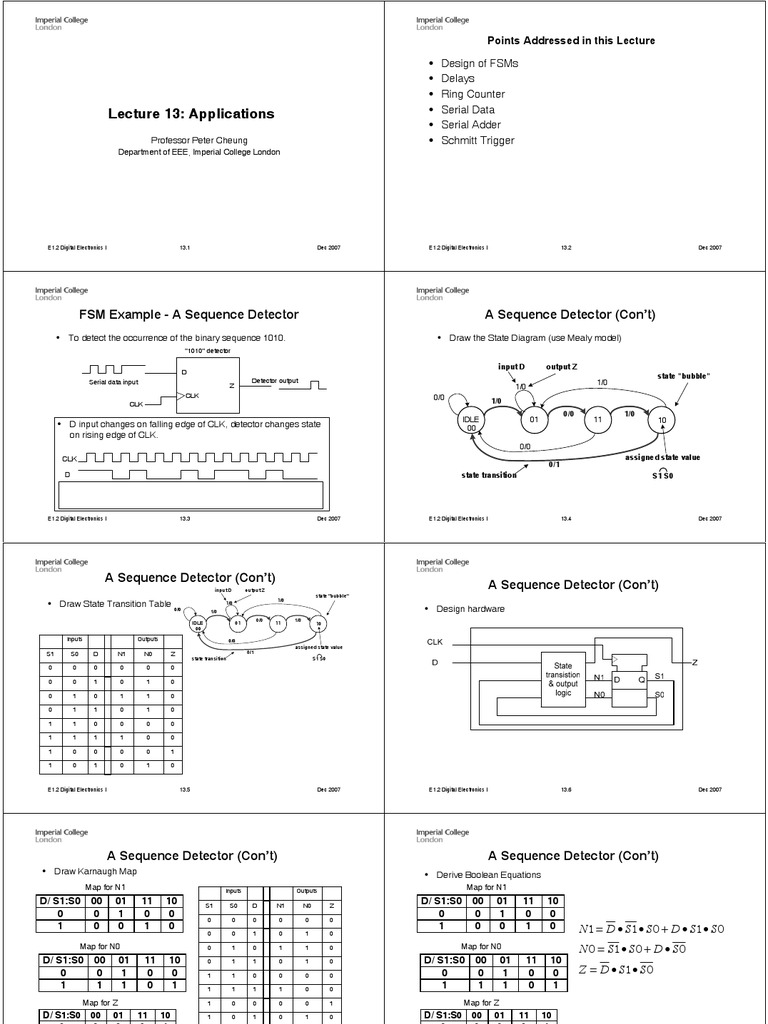
Posted : admin On 23.08.2019In states G and H of the Mealy machine it is possible to produce two different output depending on the valuation of the inputs a and b. • The Moore machine must have more than 2 states. • Split each state into two states. G: G0 and G1 (carry is 0, sum is 0/1). H: H0 and H1 (carry is 1, sum is 0/1). Moore FSM of Serial Adder. A D–flipflop is used as the storage element. For those of you concerned with titles, the serial adder in Figure 2 is a Mealy–type finite state machine. It is a Mealy model because the output S is a function of both the present state z and the inputs A and B. (If it were a Moore model S would effectively be a function of the present state only.). Interact with the Adder–Mealy's finite state machine digital circuits to see its function and Truth Tables, boolean function, binary logic; You can also build and simulate your own digital circuits.
What is the difference between Mealy & Moore type of finite state machines?
6 Answers
In a Moore machine the output produced is associated to the current state of the machine and on it only. In a Mealy machine, instead, it is associated to both a state and a specific input.
From a practical point of view you have that output is placed on states in a Moore machine (so every state has its ouput), while on the latter you have outputs on transitions (so an ouput is decided from the current state AND the outgoing transition)

Moore machine output is a function only of the state of the machine,Mealy machine output is a function of the state of the machine and its inputs.
OrbitOrbitMoore machines are discrete dynamical systems which can be expressed in the form:
where x the state, u the input, y the output, f describes the transition relation (discrete dynamics) and g the output map (here a state labeling) and k denotes time (index in the sequence).
A Mealy machine is of a slightly more general form:
Note that now g is not a state labeling any more, it is an edge labeling.
They are not equivalent, in particular Moore machines are strictly causal, whereas Mealy machines are not.
For more details, refer to Lee & Seshia, Introduction to Embedded Systems, LeeSeshia.org, p.58.
Ioannis FilippidisIoannis FilippidisExplanation by Example / Anecdote.
This is perhaps best illustrated with an example and an anecdote.
I hate airports, and getting to them, but I love being on the plane. There are three distinct states that I have to enter into before getting on the plane:
- State: In Taxi (event: then I pay the fare, and transition to the next state:)
- State: In Lounge (event: wait 2 hours, and transition to the next state: )
- State: In Plane
But what is the outcome?
In a Mealy machine, the preceding state from which you come from makes a difference - how you get somewhere is very important. In a Moore machine, how you get to a state makes no difference.
Let's add in an outcome to the above to create a Moore representation of a state machine:
Example of a Moore Representation of a State Machine:
- State: In Taxi (event: pay fare and then transition to the nextstate). (Outcome: unhappy).
- State: In Lounge (event: wait 2 hours, and then transition to the next state) (outcome: unhappy)
- State: In Plane (outcome: happy).
With a Moore representation the outcome is attached directly to the state. With a Mealy representation - the particular outcome/output depends on where you have come from. For example, if I can get to the plane without having to catch a taxi and wait in the lounge, then I would be happy. Inputs make a difference. The where you come from is important. A Mealy representation state machine allows for this to be shown in the diagram. In other words, the output/outcome is shown OUTSIDE the state, during the transition.
BKSpurgeonBKSpurgeonMoore changes only after active clock pulse and Melay changes after every clock edges ('if external input changes ')
Mealy machine output depend on both upon current state and current inputwhereasMoore output depend only the current state.
Generally Mealy machine has fever state than Moore machine.
Mealy Output changes at the clock edged but Moore output change as soon as logic is done.
Mealy react faster to input whereas Moore login is needed to decode the output since it has more circuits delays.

I've a design problem in VHDL with a serial adder.The block diagram is taken from a book.
Since i'm not skilled enough in design with clock (except some silly flip flop i've found on the web, and similarly a register, where the design is pretty much the same) i have some problem in the design.
I would start with a register (n bit) a full adder and than a flip flop as basic component. Register and flip flop should be updated and shift for every clock cycle, the full adder is combinatorial so it is ok. I'm not sure however how the whole entity for the adder should be designed i would attempt with something like

The internal architecture confuse me a lot since actually i don't know how to behave in the synchronization stuff.. At high level i would say probably internally should be even a counter that probably keep track of when all the bits are being processed. But i'm not sure if this is the right way to perform this design, i would like to keep as much close i can to the diagram i posted.
Any suggestion for such simple design?
Mealy Type Fsm Serial Adder Code
Update..
Ok here i have my first attempt for the design.. I splitted in three process, first process for handling the input registers, second for handling the full adder and third for handling the register z, i sync with a clock signal and i think i've written a correct sensitivity list for each process. Input signal are also clk, load and clear. Clk is the clock, load is to write the x,y value in the registers while clear is to clear registers and flip flop. Pleaaaaaaaaaase give me any feedback!!!
1 Answer
$begingroup$z : out std_logic_vector(n - 1 downto 0));The output must be std_logic, because it is a serial output
Also, you can use the + operator directly to the std_logic_vectors. Just add the 'ieee.std_logic_signed' librarySo that you can write z_reg <= x+y;
if rising_edge(clk) then if clr = '1' then --clear all the registers, and flip flop